
OSLO – Frequently Asked Questions
Do you have any questions about OSLO, our business areas, your future working arrangements, recruitment or training? You’ll find answers to the most frequently asked questions here to help you as you consider your career plans.
 Updated on 19 October 2026
 4-minute read
Discover OSLO
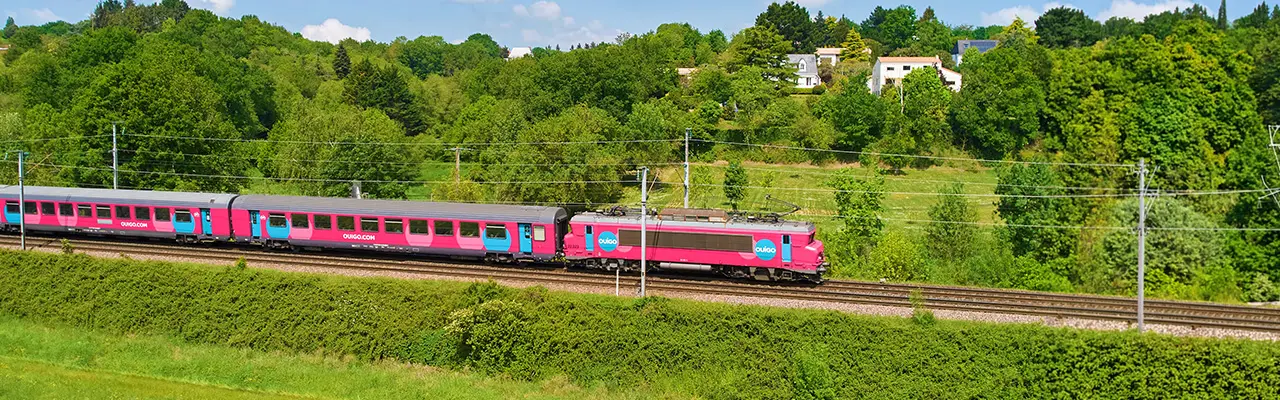
OSLO is a railway company and a wholly-owned subsidiary of SNCF Voyageurs, which, as a service provider, operates the OUIGO Train Classique service.
The company recruits, trains and supports its staff in various railway roles, particularly in the areas of train driving, on-board service and support functions.
Although it belongs to the SNCF group, OSLO is a railway company with its own organisation, operating rules and terms and conditions of employment.
Working at OSLO means:
- Joining a railway company on a human scale with around 120 staff.
- Making a difference every day within a company founded on the values of community, commitment and innovation. These values are at the heart of everything we do.
- Playing an active role in the company’s development
No, OSLO is a subsidiary of SNCF Voyageurs.
Employees are therefore employed by OSLO and are entitled to the terms and conditions of employment and schemes specific to the company (as set out in our job vacancies).
Consequently, the terms and conditions of the parent company, SNCF, or of other companies within the SNCF Group should not automatically be equated with OSLO’s terms and conditions of employment.
Discover the careers at OSLO
There are two main categories of roles in the rail industry: train driving and on-board staff.
These are operational and mobile roles, which involve travelling as part of one’s work and working on board trains according to operational requirements.
Safety and adherence to procedures are of paramount importance. Every employee must be able to apply procedures rigorously and make the decisions expected of them within the scope of their responsibilities.
The qualities that are particularly important are:
- Attention to detail
Adherence to procedures and safety rules. - Punctuality
A shift cannot be rescheduled, as is the case in some office-based roles. - Independence
Be able to take responsibility in an operational and high-risk environment. - Flexibility
Accepting variable working hours, weekends, public holidays and overnight stays away from home. - Self-management
Knowing how to manage one’s fatigue, stress and emotions in a demanding environment. - Adaptability
Be able to adapt to operational constraints and changing circumstances. - Responsibility
Ensuring the safety of passengers throughout the journey. Being aware of the challenges relating to customer satisfaction in passenger transport. - Good interpersonal skills
A train driver is required to liaise with various stakeholders within the rail system; it is therefore essential to be comfortable working collaboratively and interacting with a variety of people (on-board crew, rail traffic control staff and, where applicable, passengers).
It is not simply a matter of ‘travelling’.
The role is, first and foremost, an operational role within the railway sector. Travel and overnight stays are part and parcel of the demands of roles involving travel on the railway network.
You must therefore be comfortable with working on the move and not always being in the same place.
Organisation and work patterns
Yes, the job involves overnight stays.
An overnight stay means that the employee finishes their shift in another town and spends the night there before resuming work according to their rota.
The number and frequency of overnight stays depend, in particular, on the nature of the work, the rota and the organisation of shifts (around 2 to 3 per week).
It is therefore important to be comfortable with the fact that you will not always sleep at home after every working day.
No, the job of a delivery driver requires real flexibility in terms of working hours.
Working hours are linked to the train timetable and may vary in the event of unforeseen circumstances.
Employees may be required to work:
- early in the morning;
- during the day;
- in the evening;
- at weekends;
- on public holidays, depending on the rota and the organisation of the business.
It is therefore important to be able to adapt well to variable working hours, as well as to irregular days off.
No.
The rota is drawn up according to operational requirements and shift patterns.
Employees therefore do not choose their own daily working hours.
It is important to be able to organise oneself around a work rota with variable working hours.
No.
Shifts start and end in Paris (Austerlitz, Gare de Lyon, Montparnasse).
You must therefore be able to travel to OSLO’s offices, located near Gare de Lyon, on a daily basis, both during daytime hours and on shift work.
Pick-up and drop-off points outside Paris apply only in cases where an overnight stay is required.
Yes, that can happen.
Our trains run every day of the week. The job therefore involves working on Saturdays, Sundays and public holidays, depending on the rota.
Working days and days off are determined by the service rota.
The job can be compatible with family life, but it requires good personal organisation.
The main challenges to be aware of are:
- unusual working hours;
- early morning shifts;
- late finishes;
- working at weekends;
- working on public holidays;
- overnight stays .
It is therefore important that candidates are aware of these constraints before committing to a career in our transport roles.
Yes.
Employees are given a timetable in accordance with the way the business is organised.
However, in the context of railway operations, a certain degree of flexibility must be maintained and employees must accept that the organisation may change in line with operational requirements, particularly in the event of unforeseen circumstances.
Training and recruitment process
Not necessarily.
OSLO recruits candidates who do not have a background in the rail industry, provided they meet the job criteria and successfully complete the recruitment process.
Candidates are then trained in the skills required for the role.
What is particularly important is the ability to learn, a meticulous approach, a sense of responsibility, motivation anda willingness to adhere to the demands of the job.
The training enables participants to gradually acquire the knowledge, technical skills and safety rules required to carry out the job.
It comprises a theoretical component and a practical component, with assessments to verify that the skills have been acquired.
The training therefore requires a significant commitment and a great deal of personal effort.
The training is demanding, as it prepares you for a profession in which safety procedures are essential.
You must be able to:
- learn the regulations;
- to memorise procedures;
- understand operational situations;
- to stay focused;
- work consistently.
Motivation alone is not enough: you must also be prepared to commit fully to the training.
The right question isn’t just:
‘Am I interested in the job?’
You also need to ask yourself:
‘Does my personal organisation allow me to work irregular hours, at weekends, on public holidays and at night away from home?’
If the answer is yes, the candidate will then be able to envisage a career as a driver with OSLO with greater peace of mind.
Consequently, becoming a driver (on board or behind the wheel) is a career path that requires careful consideration and a long-term career plan spanning several years.
Depending on the role, certain stages may vary:
- CV screening
- Telephone interview: to assess thecandidate’s expectations and needs, and to determinetheir suitability for the role and the company
- Psychometric tests: depending on the role
- Job interview: to confirmthat the candidate’s profile is suitable for the role
- Physical and psychological assessment: depending on the role
Each stage aims to ensure that the candidate possesses the skills, aptitudes and ability to carry out the job safely.

Header : © Maxime Huriez
See also : © Maxime Huriez / SNCF Voyageurs / Christophe Recoura