
CSR and Transitions
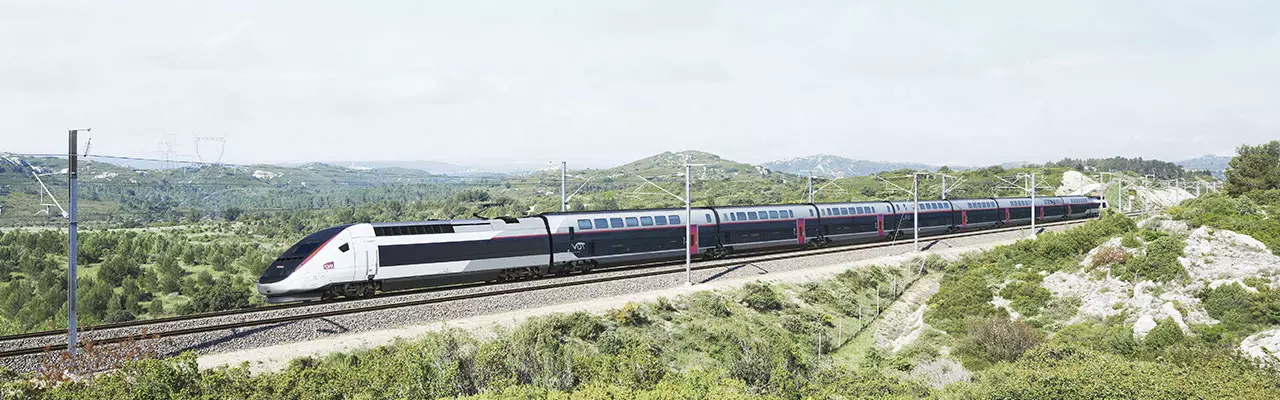
Our aim: to make you choose the train
We are currently witnessing a new golden age for rail, driven in particular by the climate emergency. As the mode of transport with the lowest carbon emissions, we have a responsibility to play our full part in a decarbonised society by making rail the backbone of mobility.
Our targets for 2030
- Reduce greenhouse gas emissions from transport by 30 per cent and those from the building stock by 50 per cent (compared with 2015)
- Recycle 100 per cent of recyclable waste and strengthen the principles of the circular economy
- Reduce our water consumption by 20% (compared with 2022)
- Through rail travel, avoid 20 million tonnes ofCO₂ein the transport sector’s carbon footprint
- 100 per cent of staff trained in CSR principles
Transport carbon comparison tool
Travelling by train in France reducesCO₂eemissions by an average of 90% compared with an equivalent journey by road or air.*
* Comparison based on the full scope of emissions. Average figure. Air travel is compared solely with the TGV.
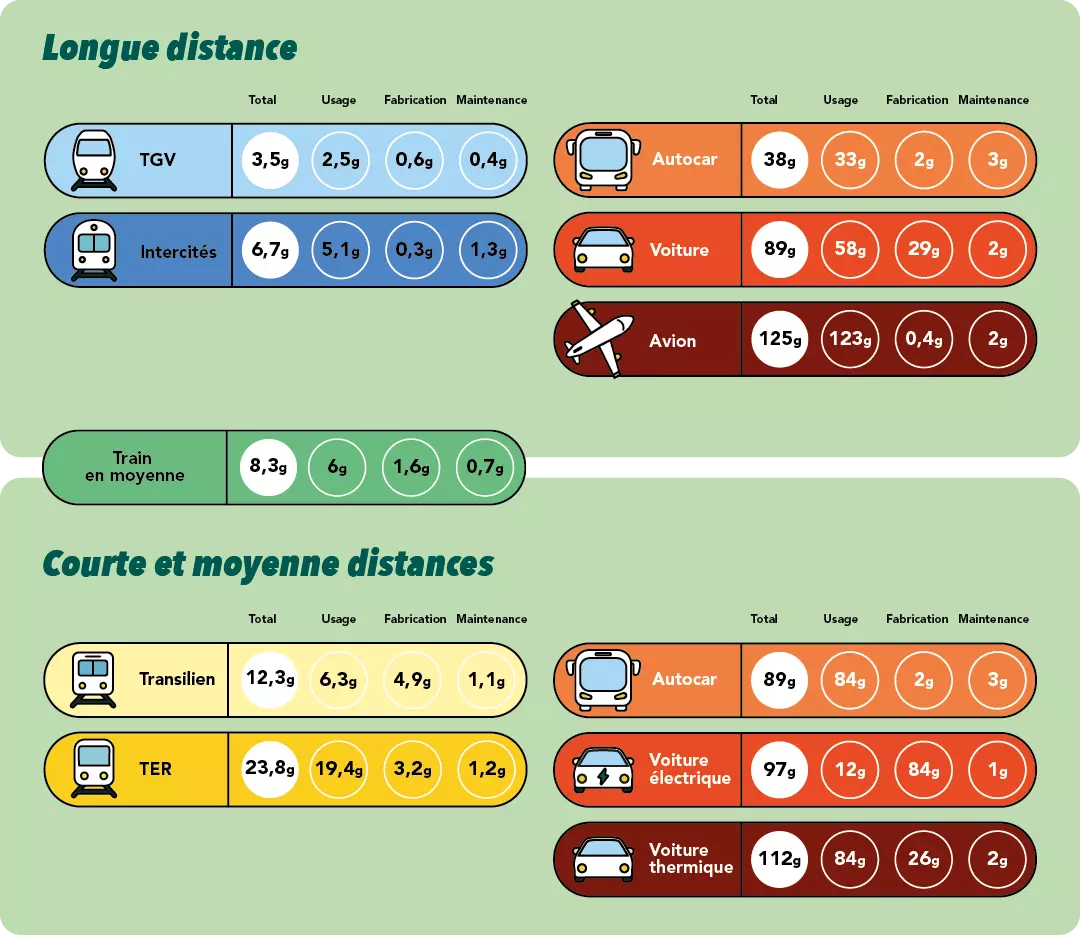
Table showing the greenhouse gas emissions of a passenger travelling one kilometre in France, taking into account the impact of the vehicle’s use, manufacture and maintenance (gCO₂e/passenger/kilometre).
Comparison of long-distance data, in ascending order:
- TGV (3.5 grams of CO₂e in total, of which 2.5 grams of CO₂e is from use; 0.6 grams of CO₂e from manufacture; 0.4 grams of CO₂e from maintenance)
- INTERCITÉS (6.7 grams of CO₂e in total, of which 5.1 grams of CO₂e is from operation; 0.3 grams of CO₂e from manufacturing; 1.3 grams of CO₂e from maintenance)
- Coach (38 grams of CO₂e in total, of which 33 grams of CO₂e are from operation; 2 grams of CO₂e from manufacturing; 3 grams of CO₂e from maintenance)
- Car (89 grams of CO₂e in total, of which 58 grams of CO₂e are from use; 29 grams of CO₂e from manufacturing; 2 grams of CO₂e from maintenance)
- Aircraft (125 grams of CO₂e in total, of which 123 grams of CO₂e are from use; 0.4 grams of CO₂e from manufacturing; and 2 grams of CO₂e from maintenance).
- Train (8.3 grams of CO₂e in total, of which 6 grams of CO₂e are from use; 1.6 grams of CO₂e from manufacture; 0.7 grams of CO₂e from maintenance).
Comparison of short- and medium-distance data, in ascending order:
- Transilien (12.3 grams of CO₂e in total, of which 6.3 grams of CO₂e is from use; 4.9 grams of CO₂e from manufacturing; 1.1 grams of CO₂e from maintenance)
- TER (23.8 grams of CO₂e in total, of which 19.4 grams of CO₂e are from use; 3.2 grams of CO₂e from manufacturing; 1.2 grams of CO₂e from maintenance)
- Coach (89 grams of CO₂e in total, of which 84 grams of CO₂e are from use; 2 grams of CO₂e from manufacturing; 3 grams of CO₂e from maintenance).
- Electric car (97 grams of CO₂e in total, of which 12 grams of CO₂e are from use; 84 grams of CO₂e from manufacturing; 1 gram of CO₂e from maintenance)
- Internal combustion engine car (112 grams of CO₂e in total, of which 84 grams of CO₂e are from use; 26 grams of CO₂e from manufacturing; 2 grams of CO₂e from maintenance)
For long-distance journeys, the data for car travel is based on a mix of electric and internal combustion engine cars. An average occupancy rate of 2.2 passengers is applied, corresponding to long-distance travel.
For short and medium-distance journeys, for car journeys, an occupancy rate of 1.6 passengers is applied, corresponding to medium-distance travel.
The data for coaches is calculated based on an average of the three types of coach (long-distance, inter-city and Île-de-France), weighted by the actual distances travelled.
For SNCF Voyageurs transport modes, 2024 figures are used for the usage, manufacturing and maintenance components (emissions related to maintenance include only the energy consumption used for the maintenance of our trains).
For other modes of transport, ADEME’s ‘Base Empreinte’ values are used for the usage and manufacturing components, and values from the Carbone 4 study for SNCF are used for the maintenance component.

Header : © Alex Profit
News : © SNCF Voyageurs / ©SNCF Voyageurs / Maxime Huriez / ©Shutterstock / Com à l'écran
Infographic : © SNCF Voyageurs
See also : © Christophe Recoura / Sébastien Godefroy / Christophe Recoura