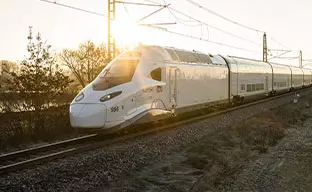
45 years of expertise for a new generation of TGVs

    With its new TGV, SNCF Voyageurs is building on 45 years of expertise in high-speed rail to offer a train that is both more sustainable and more comfortable.

    Updated on 6 November 20265-minute read

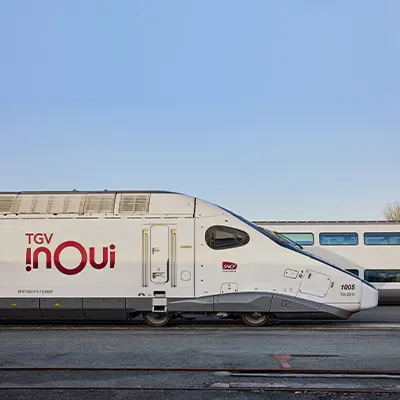
    Forty-five years after the first ‘high-speed train’ set off on its maiden journey between Paris and Lyon in September 1981, the SNCF Group is opening a new chapter in its industrial and railway history. The New Generation TGV, designed in collaboration with Alstom, enters commercial service on the south-east route this Friday, 6 November.

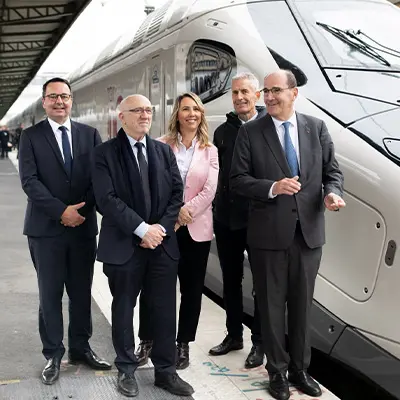
    At 09:56, the first Nouvelle Génération TGV departed from Gare de Lyon on Friday 6 November 2026, carrying Jean Castex, CEO of the SNCF Group, Philippe Tabarot, Minister for Transport, as well as Martin Sion, Chief Executive of Alstom; Jean-Aimé Mougenot, Chief Executive and Deputy Director for TER at SNCF Voyageurs; Karine Dussert-Sarthe, Deputy Chief Executive of SNCF Voyageurs and Chief Executive of TGV-INTERCITÉS, and Alain Krakovitch, Deputy Chief Executive of SNCF Voyageurs and Director of Rolling Stock.

    More than just a fleet renewal, this new TGV embodies over four decades of French expertise in high-speed rail, whilst addressing today’s challenges in terms of energy efficiency, the passenger experience and comfort.

    400

    innovations are incorporated into the new-generation TGV

    + 1 600

    Customers took part in trials of the new-generation TGV

    20 %

    in terms of energy savings, the TGV has the lowest carbon footprint

    From speed records to records of innovation
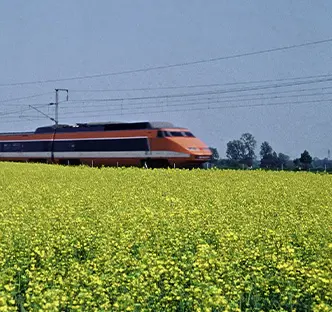
    When the SNCF launched its first high-speed train in 1981, travelling at 260 km/h, the main aim was to deliver high performance in order to compete with air travel within France. Over the past 45 years, the state-owned company has carried several billion passengers, increased commercial speeds to 320 km/h, pioneered the double-decker design with the TGV Duplex in the 1990s to relieve congestion on the lines, and set the world rail speed record of 574.8 km/h in April 2007.

    Almost 20 years ago, on 3 April 2007 at 1.13 pm, TGV POS train No. 4402 set a new official record of 574.8 km/h (a speed of 159.6 m/s) on the LGV Est européenne at km 193.2, near the village of Le Chemin in the Marne department.

    This technical expertise, gained through practical experience, has enabled engineers at SNCF Voyageurs and Alstom (via its Avelia Horizon platform) to completely rethink the train’s architecture. Boasting nearly 400 innovations, the New Generation TGV no longer seeks to break speed records, but to optimise every square metre, every kilowatt-hour and every maintenance operation.

    Unprecedented modularity designed to enhance the passenger experience

    The TGV’s true technological breakthrough lies in its industrial flexibility, which stems directly from feedback from SNCF Voyageurs’ operators:

    • By reducing the size of the two power cars at either end through the use of more compact motors, the train’s passenger carriage count has increased from eight to nine. This yields a 17 per cent increase in space compared with current Duplex trains, without increasing the train’s overall length, which remains at 200 metres.
    • For the first time in the history of the TGV, the number of carriages in a train can vary (from 7 to 9 carriages) depending on requirements. Better still, a first-class carriage can be converted into a second-class carriage — and vice versa! — in just one day in the workshop.
    • Fitted with thousands of on-board sensors, the TGV transmits real-time data on the condition of its mechanical components, doors and air-conditioning to the SNCF Voyageurs technical centres. This proactive approach reduces maintenance costs by 30 per cent and increases the availability of trains on the network.

    The Ecological Transition Train

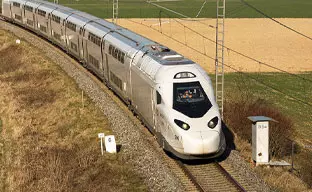
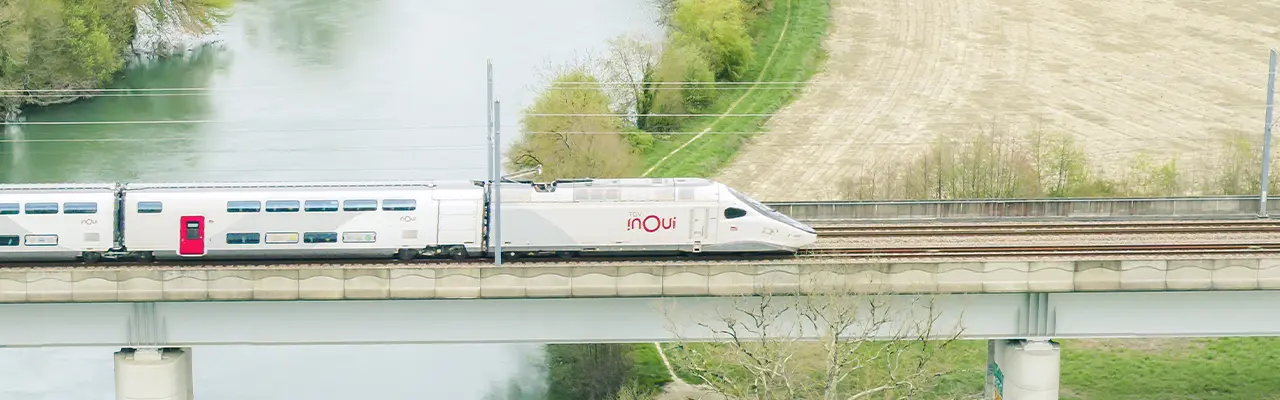
    Thanks to its aerodynamic profile (+9 per cent) and regenerative braking, the New Generation TGV delivers energy savings of up to 20 per cent. This energy saving is due to a longer ‘nose’ made of composite materials, which cuts through the air more efficiently at 320 km/h, as well as the systematic feeding of the electricity generated during braking directly back into the overhead line.

    Thanks to eco-design right from the assembly stage, the recyclability rate has soared from 90 per cent to 97 per cent. Combined with an increase in passenger capacity, the carbon footprint per seat falls by more than 32 per cent, giving the New Generation TGV the lowest carbon footprint on the high-speed rail market.

    Whilst rail is emerging as the key means of achieving carbon-free transport in Europe, the New Generation TGV boasts environmental performance that is significantly superior to that of previous generations.

    More accessible and comfortable spaces
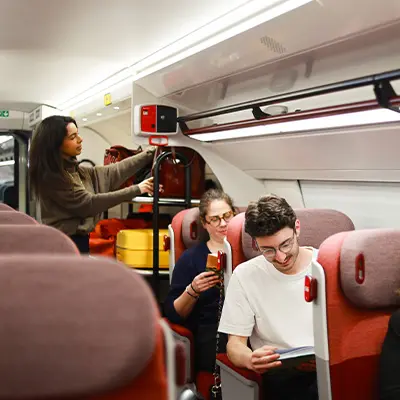
    The result of nearly half a century of experience and collaboration with Arep and the Nendo studio, the TGV Nouvelle Génération completely reimagines the on-board experience to offer greater accessibility and comfort.

    Fitted with an integrated lifting platform, the train will, for the first time, enable passengers with reduced mobility to board and access a dedicated area with five seats on the ground floor.

    The ‘Le Bistro’ bar-on-wheels now operates on two levels, with self-service vending machines downstairs and a bright mezzanine with seating for 28 upstairs.

    As well as 15 per cent larger glass surfaces and eco-designed seats, whilst enhancing facilities for non-motorised transport with expanded cycle spaces, each seat is designed as a cosy, more comfortable and personalised space, much like its new lamp, which is already set to become an icon.

    Furthermore, the inclusion of an autonomous battery-powered backup system ensures that air conditioning, lighting and movement at reduced speed are maintained even in the event of a power cut on the track.

    A new generation of TGVs

    By combining the industrial excellence of its partner Alstom with the long-standing expertise of railway workers, the New Generation TGV proves that, 45 years on, the French high-speed model has lost none of its ability to reinvent European rail.

    Its launch on Friday 6 November 2026 should therefore not only write a new chapter in the long history of rail in France, but also leave a lasting impression on millions of French people who are fond of this innovative and carbon-free mode of transport.

    See also

    Behind the scenes of the TGV M

    Read more

    End of trials for the TGV INOUI

    Read more

    The construction of the future TGV INOUI

    Read more

    Header : © Olivier Foulon

    Paragraph : © Mathieu Raffard pour SNCF Voyageurs

    From speed records to records of innovation : © SNCF Médiathèque / Paul Billet

    The Ecological Transition Train : © Yann Audic pour SNCF Voyageurs

    More accessible and comfortable spaces : © Astride Fourcade pour SNCF Voyageurs

    See also : © Yann Audic / Julien Golsteim pour Alstom