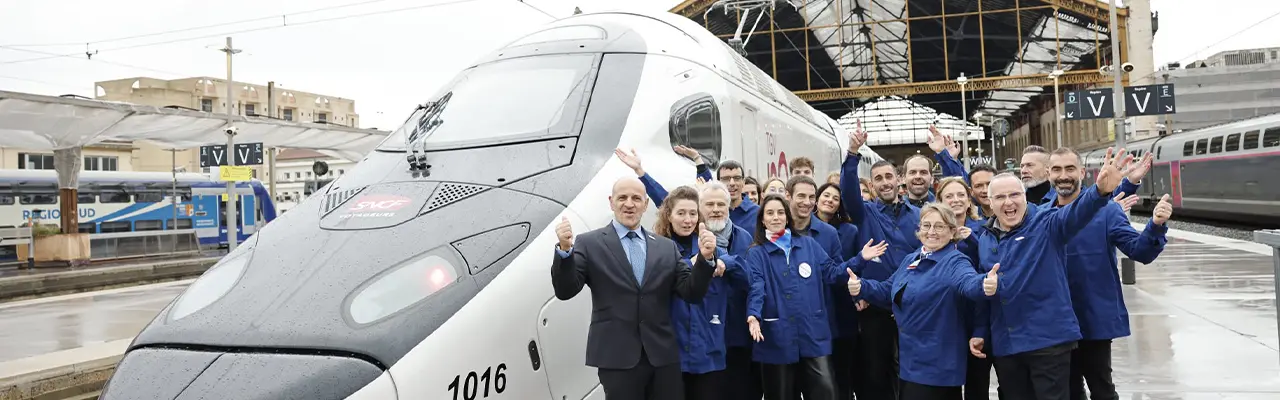
Arrivée du TGV Nouvelle Génération à Marseille

    The New Generation TGV, as told by the people who built it

    Rethinking high-speed rail from top to bottom: this is the challenge taken up by SNCF Voyageurs with the TGV Nouvelle Génération. The teams working on the project recount an extraordinary human and technical adventure.

    Updated on 16 November 20264-minute read

    Designed to offer greater comfort whilst reducing its energy footprint and operating costs, the New Generation TGV will carry passengers for decades to come. To ensure the success of its launch, this new train has involved hundreds of engineers, designers and experts from a variety of backgrounds over several years. Behind the technical specifications and performance promises, it is above all the men and women who have had to reinvent their roles to bring this new-generation train to life.

    A design that blends precision with Franco-Japanese sensibility

    To visualise the layout and ambience of this new train, and to challenge the traditional conventions of railway design, SNCF Voyageurs entrusted the design of the interior fittings to the AREP–Nendo partnership, which won the tender.

    “The main challenge was to reconcile a strong creative vision with the many very practical requirements of a high-speed train: industrial, safety, maintenance, accessibility, comfort and versatility. The most memorable moment was when the project moved beyond plans, images and prototypes to become a real space. It is at that moment that one fully realises how innovation, poetry and a sense of calm combine to give rise to a comprehensive design that is both ambitious and human. ” explains Naoko Nishizu Audic, Specialist Manager for Spaces & Products at AREP, a subsidiary of SNCF Gares & Connexions.

    “The most memorable moment was when the project moved beyond the plans, images and prototypes to become a real space.”

    Naoko Nishizu Audic, Specialist Manager for Spaces & Products at AREP

    “Immersion in the field was the real starting point, with those formative immersion phases during which we were able to get to the heart of the industrial tools, to tackle head-on all the technical and physical complexity of this world. Finally, as with any creative process, what stands out for me is the intense emotion of encountering our first prototypes of seats, lamps and the bar…: it’s always a great moment to see the design efforts become a reality, come to life and take shape. To finally be able to touch them, walk round them, test their strength and, of course, discover their weaknesses so we can address them later,” adds Isabelle Le Saux, Head of Design at SNCF Voyageurs.

    Accessibility designed through collaborative development

    One of the major innovations introduced by the New Generation TGV concerns facilities for passengers with reduced mobility (PRM). Rather than retrofitting finished rolling stock, these requirements were incorporated into the design from the very outset, when the specifications were drawn up.

    Alexandrine Capillon

    “For the first time, a high-speed train has been designed from the outset to meet the needs of people with disabilities, thanks to ongoing dialogue between user organisations and the SNCF’s design teams. During the initial tests, we saw how pleased wheelchair users were to discover a system enabling them to board and alight from the train without assistance. For them, this is a significant step towards independent travel,” adds Alexandrine Capillon, Head of Accessibility for TGV-INTERCITÉS.

    Ultimately, passengers with reduced mobility will be able to reach the carriage or leave the train in a wheelchair, independently, in under a minute.

    The first track trials

    Before carrying passengers, the rolling stock had to undergo a rigorous certification programme. For the technical teams responsible for validating each component, the standards were extremely high.

    Laurent Gil

    “The biggest challenge was to build a train that performed as well as today’s trains. Our predecessors had done such a good job that the bar was set very high. In the case of the New Generation TGV, we were starting from scratch with an entirely new train. We had to repeat all the static and dynamic tests to obtain the Marketing Authorisation (MA) and thus ensure the new TGV could enter commercial service. “The final major challenge was organising and carrying out on-track tests amongst commercial trains,” explains Laurent Gil, Head of Testing and Validation for the New Generation TGV.

    “The biggest challenge was to build a train that was just as efficient as today’s trains.”

    Laurent Gil, Head of Testing and Validation for the New Generation TGV

    New habits in the cockpit

    New driving practices have also taken shape in the cab. Drivers have had to learn new ways of driving after decades of relying on habits acquired from previous generations of vehicles.

    Antoine Leroy

    “The first challenge was to familiarise ourselves with this brand-new, revolutionary train: to understand how it worked and to get to grips with driving it, which was a complete departure from anything we had experienced before. The second challenge lay in developing the right driving techniques and new reflexes for testing this eagerly awaited New Generation TGV. To meet these challenges, we started with a completely blank slate. We had to set aside our in-depth knowledge of the existing TGV fleet and accept that we were starting from scratch. It was a real test of our abilities, despite the years of driving experience we had behind us,” says Antoine Leroy, a New Generation TGV test driver.

    By combining bold design, ergonomic redesign and a technological leap forward, the New Generation TGV does more than simply take over from a historic fleet: it redefines the standards of the passenger experience and rail travel. Following years of rigorous testing and collective reflection, the train is now set to face its most demanding test: everyday use by the general public on the high-speed network.

    Header : © Clara Ferrand

    Paragraph : © Naoko Nishizu Audic / Aurore Baron pour SNCF Voyageurs / SNCF Voyageurs / Laurent Gil / Antoine Leroy